Project ADORE and Singapore Specials: A Full Adopter’s Guide
By PetBuddy.sg TeamPublished 29 October 2026
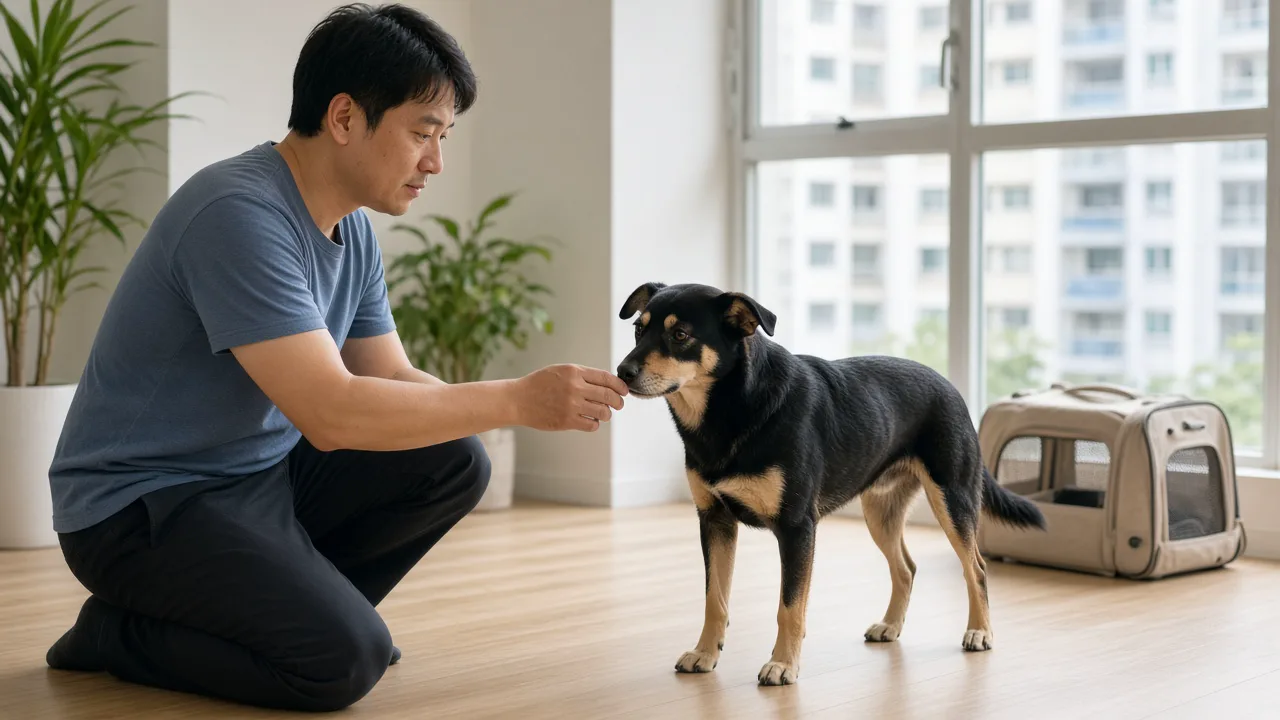
Paperwork done? Find somewhere to take the new dog.
You’ve seen the dog. It’s on a shelter page, mid-sploot, looking like it has opinions about your sofa. It is also, by your estimate, about the size of a medium suitcase. And you live in an HDB flat.
This is where most people close the tab. Don’t. There’s a scheme for exactly this situation, and it’s been around longer than most people realise.
Short answer: yes, you can adopt a Singapore Special into an HDB flat, through Project ADORE. The dog has to qualify, you have to qualify, and there’s paperwork plus a mandatory training course. It’s less scary than the WhatsApp auntie network makes it sound. Project ADORE Singapore is the scheme people mean when they ask about an HDB big dog: a local mixed-breed outside the ordinary list of HDB approved dogs.
What is Project ADORE?
ADORE stands for ADOption and REhoming of dogs. It’s a scheme led by AVS (the Animal & Veterinary Service under NParks) and supported by HDB. It lets an HDB household keep one mid-sized local mixed-breed dog, the Singapore Special, even though most of them are well outside the HDB approved dog breeds.
It began as a pilot by the Ministry of National Development in April 2012 and became permanent in May 2014. In March 2020 the height limit went from 50cm to 55cm and the old 15kg weight cap was dropped. AVS formalised that change in 2022. The AVS Project ADORE page, last updated 17 September 2026, is the rulebook. This is not a loophole, and it is not a pilot that might vanish next month.
Project ADORE requirements
Two checklists. One for the dog, one for you. AVS decides the scheme. The shelter decides whether the dog in the photo actually qualifies.
The dog
- A local mixed-breed dog, a Singapore Special. A purebred from a breeder or a pet shop does not count. Retired sniffer dogs are a separate list, further down.
- Up to 55cm in height. There is no weight limit. SOSD and ASD describe the measurement as shoulder height.
- Sterilised, vaccinated, microchipped and licensed.
- Adopted through one of AVS’s rehoming partners, listed below. You can’t self-certify a dog as “basically a Special.”
Age is where hopeful puppy photos go to die, and that is the scheme working. SOSD’s HDB page wants an ADORE dog to be at least 6 months old and already sterilised. ASD says a dog’s full-grown size can only be properly judged at around seven to eight months, and its adoption procedure does not place puppies with HDB residents. The 3-month-old with paws the size of your fists is probably not coming home to your flat.
You
- One dog per residential unit. AVS’s wording is the unit. A second small dog is still a second dog.
- Sign the Code of Responsible Behaviour (CORB). That is the “your dog will not be the reason your neighbour starts a feedback email” agreement. It includes not causing a nuisance.
- Complete a mandatory obedience programme with the dog, run by an AVS-Accredited Certified Dog Trainer or an ADORE dog trainer. The AVS trainer list is the accreditation check. Our dog training guide explains what that certificate is for, and the trainer directory is a place to start asking for quotes.
- Licence the dog with AVS. The dog and cat licence guide walks through PALS. A licence is not HDB’s permission to keep the dog.
Eligibility is decided dog by dog, and the shelter confirms it. SPCA’s adoption page tells people to double-check with staff, because some Singapore Specials may qualify for ADORE even when the gallery tag doesn’t say so. “HDB-approved” on a listing is a starting point, not the final word. SPCA also says window grilles on every window are mandatory for a Project ADORE adoption from them. That line is on SPCA’s page. It is not on the AVS page, so ask the group you apply to whether they require grilles.
Who you can adopt a Singapore Special from
AVS lists six partners for Project ADORE. A couple of older posts still name three or four. The list below matches the AVS page, last updated 17 September 2026. If another website disagrees, trust the government page. What each group actually does day to day is sketched in pet charities in Singapore.
- Action for Singapore Dogs (ASD)
- Causes for Animals (Singapore)
- Exclusively Mongrels
- Mercylight Animal Rescue & Sanctuary Limited (MARS)
- SOSD Singapore
- Society for the Prevention of Cruelty to Animals (SPCA)
What the adoption process looks like
Every shelter does it slightly differently. SOSD publishes the steps, so here is theirs.
- Register your interest. SOSD asks for an adopter sign-up form and a pre-adoption briefing. Set aside an hour. Its HDB page says to attend the briefing before you sign up. The briefing is useful: SOSD is explicit that a cute puppy is a poor reason on its own, and that rescues need patience.
- Screening. A rehoming volunteer calls, answers questions, and walks you through what comes next.
- House visit, then time with the dog. The visit checks that the home is dog-proofed and that everyone in the household is on board. Yes, that includes the person who said “fine, whatever” and is quietly planning to be elsewhere when the dog needs walking.
- Buy what the volunteer lists, and dog-proof the flat. SOSD provides an essential kit: collar, leash and tracker.
- Homestay of at least one week. The homestay fee is S$150. If you are adopting under Project ADORE, SOSD wants at least one session with an SOSD-recommended trainer before the adoption is finalised.
- Sign the adoption agreement and pay the S$250 adoption fee. After that: the AVS licence, continued flea, tick and heartworm prevention, and the rest of the Project ADORE training certificate. If the dog is not sterilised yet, SOSD covers that with a voucher.
ASD’s adult dogs have a two-week homestay. Puppies at ASD have no trial, and ASD does not rehome puppies to HDB residents, so that shortcut does not apply here.
SPCA’s published path is an application, a shortlist call, one or more visits, and then paperwork. Every household member, including a helper or tenant, has to attend at least one visit, and SPCA may do a home check. The current page does not describe a fixed one-week homestay. The obedience programme is still mandatory under AVS, whoever you adopt from. The general adoption guide covers how to tell a real shelter process from a social-media rush.
The homestay, where a shelter offers one, is the underrated bit. A week on your actual floor, in your actual lift lobby, tells you more than any amount of staring at a profile photo.
Project ADORE fees
The sums are modest next to buying a dog, and they still add up. These are the figures SOSD, ASD, SPCA and AVS publish. Training prices are not on those pages. Ask your partner shelter for approved trainers and get quotes before you commit. Ask Causes for Animals, Exclusively Mongrels and MARS for their current adoption fee too. The table is not a quote from them.
SOSD homestay
Published figure: S$150
What to check: At least one week. ADORE adopters also attend at least one trainer session before the adoption is finalised.
SOSD adoption
Published figure: S$250
What to check: Paid when you sign the agreement. A sterilisation voucher covers the operation if it is still outstanding.
ASD adoption
Published figure: S$400 from 15 Jan 2024
What to check: ASD says this covers vaccinations to date, microchipping and sterilisation.
SPCA Singapore Special, under 6 months
Published figure: S$250
What to check: Includes vaccination, sterilisation, deworming and a microchip. The AVS licence is extra. SOSD and ASD are unlikely to place a puppy this young in an HDB flat.
SPCA Singapore Special, 6 months to under 7.5 years
Published figure: S$150
What to check: Same inclusions. SPCA also lists S$70 for seniors and S$25 for special-needs or long-term care.
Dog licence, sterilised
Published figure: S$35 one-time
What to check: Lifetime licence for a sterilised dog among your first three pets. S$31.50 after the 10% rebate for GIRO, online or AXS. ASD quotes the rebated figure.
| Item | Published figure | What to check |
|---|---|---|
| SOSD homestay | S$150 | At least one week. ADORE adopters also attend at least one trainer session before the adoption is finalised. |
| SOSD adoption | S$250 | Paid when you sign the agreement. A sterilisation voucher covers the operation if it is still outstanding. |
| ASD adoption | S$400 from 15 Jan 2024 | ASD says this covers vaccinations to date, microchipping and sterilisation. |
| SPCA Singapore Special, under 6 months | S$250 | Includes vaccination, sterilisation, deworming and a microchip. The AVS licence is extra. SOSD and ASD are unlikely to place a puppy this young in an HDB flat. |
| SPCA Singapore Special, 6 months to under 7.5 years | S$150 | Same inclusions. SPCA also lists S$70 for seniors and S$25 for special-needs or long-term care. |
| Dog licence, sterilised | S$35 one-time | Lifetime licence for a sterilised dog among your first three pets. S$31.50 after the 10% rebate for GIRO, online or AXS. ASD quotes the rebated figure. |
Since 1 September 2024, a first-time dog or cat licence applicant has to finish the free online Pet Ownership Course before applying. AVS says it takes about 20 to 30 minutes. If this dog is your fourth licensed cat or dog, the ordinary fee is much higher. AVS keeps the lower sterilised rate for a fourth pet when the dog is a sterilised, obedience-trained local mixed-breed adopted from a rehoming partner, which is the shape of an ADORE dog. Confirm that on the AVS fee table and in the licence guide before you budget S$35.
Budget for the boring things too: a proper harness, a crate or bed, food, vet visits, and the leash you’ll replace after the first chewing incident. Vet costs in Singapore is the honest version of that last line. Find a clinic when you want the first appointment booked.
The reality check nobody puts on the poster
If you want a Singapore Special, adopt one because you want an actual dog, not a decorative one.
SOSD’s screening questions are blunt for a reason. They ask why you want a dog, whether the whole household agrees, what your week actually looks like, and who lives at home. Some dogs are fearful of sudden movement or loud noise, which is common in a home with young children. A strong dog can be too much for an older person to handle safely. The adoption process page says the point of all that is to stop impulse adoptions that end with the dog returned.
That isn’t a reason not to adopt. It’s a reason to be honest in the screening interview. Don’t tell the rehoming volunteer you’re “very active” if your current exercise routine is walking to the MRT. They are not trying to catch you out. They’re trying to avoid the dog being returned in three weeks, which is worse for everyone, most of all the dog.
And think about the neighbours. Barking is the thing that ends up in the lift notice. A dog that’s walked, trained and not left alone for ten hours a day is much less likely to become a feedback statistic. The Code of Responsible Behaviour is specifically about that.
The other ADORE: retired sniffer dogs
Project ADORE also covers retired K-9 sniffer dogs. The scheme became permanent in August 2018, and was then opened to the public, not only handlers. AVS says that public expansion was formalised in 2022. The four allowed breeds are Labrador, English Springer, Cocker Spaniel and Pointer. None of these is on the small-breed schedule. A Labrador from a pet shop is not allowed in an HDB flat just because the breed appears here. The HDB approved breeds guide keeps that distinction.
These dogs don’t sit on a shelter page waiting for you. Watch for adoption drives announced by the SAF Military Working Dog Unit, the SCDF K-9 Unit and the SPF K-9 Unit. The limit is still one dog in the flat.
Before you register interest
- Check the dog’s ADORE status with the shelter, not only from the listing.
- Confirm what the adoption fee covers, and whether a homestay fee sits on top.
- Ask for a list of approved trainers and their rates before you commit.
- Get everyone in the household on the same page before the house visit.
- Be honest about your schedule.
- After the dog comes home, book a first vet visit even when the group has already vaccinated and sterilised. The first vet appointment checklist is the practical list. Dog-friendly places are there for the walks once the paperwork is done.
Paperwork done? Find somewhere to take the new dog.